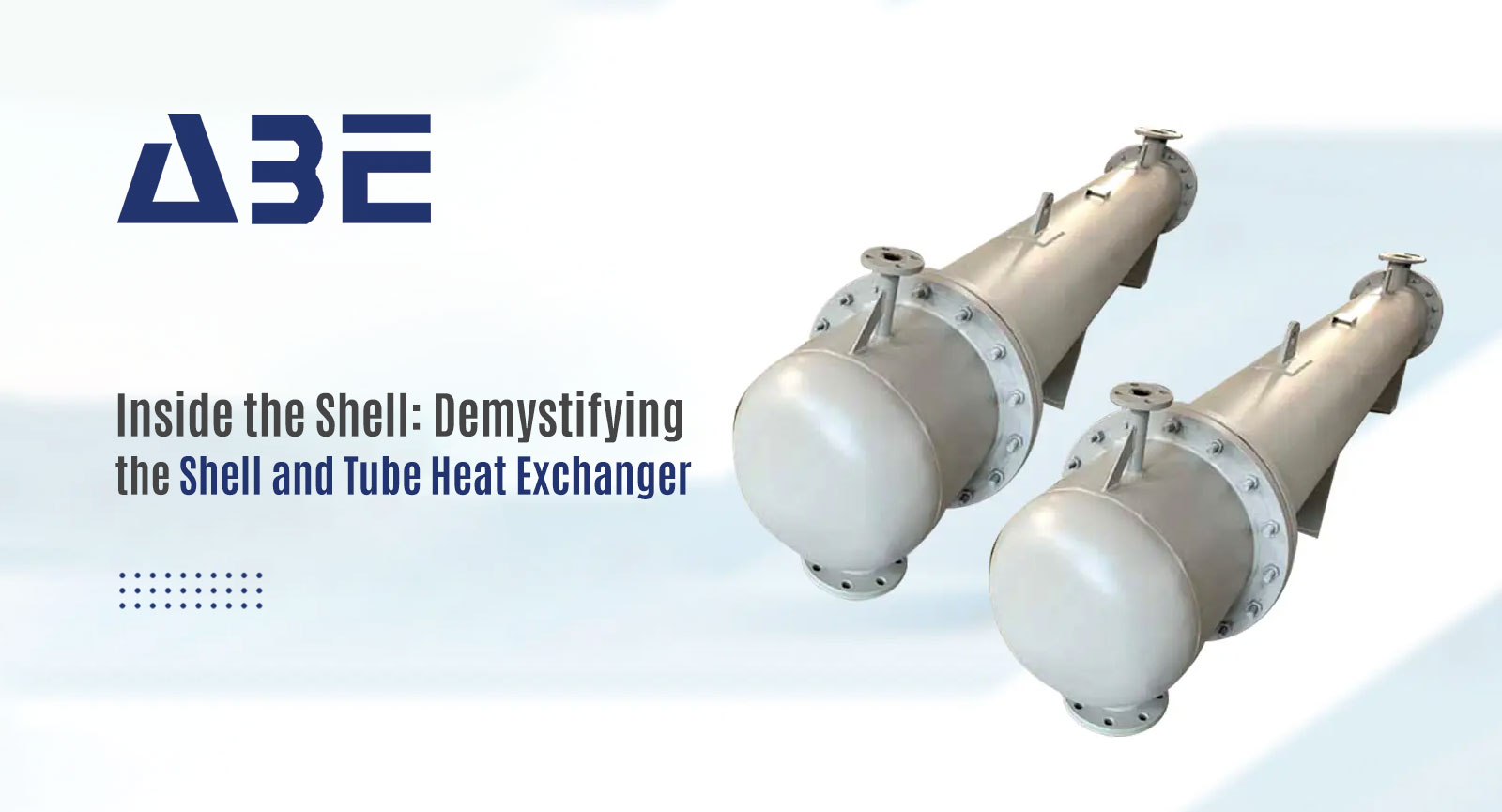
A shell and tube heat exchanger is one of the most common types of heat exchangers that has a shell (a huge pressure vessel) and a bundle of tubes within. The tubes are typically constructed of metal and placed in a parallel pattern within the shell. Two fluids can exchange heat: one flows over the exterior of the tubes and the other flows through them. Fluids can be single or two-phase, and they can flow in parallel or cross/counterflow.
The shell and tube exchanger is composed of four primary parts:
- The front header is where the fluid enters the tubeside of the exchanger. It is sometimes known as the Stationary Header.
- Rear Header—where the tubeside fluid exits the exchanger or returns to the front header in exchangers with numerous tubeside passages.
- Tube bundle—this includes the tubes, tube sheets, baffles, and tie rods used to hold the bundle together.
- The shell holds the tube bundle.
How Do Shell and Tube Heat Exchangers Work?
The process fluid (also known as hot fluid) travels through the tubes, while the service fluid (also known as cold fluid) circulates around the tubes in the shell. Heat is transmitted from the hot to the cold fluid via the tube walls.
Shell and tube heat exchangers operate on the idea of heat transfer by convection and conduction. As the heated fluid passes through the tubes, convection transfers heat to the tube walls. The tube walls, in turn, transfer heat to the cold fluid running around the tubes via conduction.
Different types of shell and tube heat exchangers
Fixed-tube sheet exchanger
The fixed-tube sheet exchanger is commonly employed in low-pressure applications. This sort of exchanger has several advantages, including straightforward construction and easy maintenance. However, it is less efficient than other types of exchangers and may be more expensive to run.
U-tube Exchanger
A U-tube exchanger is another form of shell and tube heat exchanger. This form of exchanger is more efficient than the fixed-tube sheet exchanger, but it also costs more to run. Furthermore, the U-tube exchanger needs more maintenance than the fixed-tube sheet exchanger. It is widely used in oil refineries and other chemical processing industries because it can withstand high pressures.
Floating-head Exchanger
In a floating-head exchanger, the tube component is free to move about the system. It is a form of shell and tube heat exchanger that is commonly employed in high-pressure applications. This form of exchanger is more efficient than both fixed-tube sheets and U-tube exchangers, but it also costs more to run. Furthermore, the floating-head exchanger needs more maintenance than the other two types of exchangers.
Applications of Shell and Tube Heat Exchanger
Exchangers are characterized as liquid-liquid, gas-liquid, or gas-gas based on their working fluid condition. Common applications for these exchangers in power plants are listed below.
• Auxiliary steam generators (gas-liquid and gas-gas exchangers).
• Types of liquid-liquid exchangers include bearing water coolers, blowdown exchangers, bypass condensers, component cooling water exchangers, and condensate coolers.
• Reboilers and evaporators (gas-liquid or gas-gas exchangers).
• Lube oil coolers (liquid-liquid exchangers).
Conclusion
Shell and tube heat exchangers are critical components of several industrial processes. Understanding how they function and their applications is critical when selecting the appropriate heat exchanger for your application. Abe & Hex India Pvt. Ltd. provides high-quality heat exchanger solutions that address their individual requirements. Contact us today to find out more about our heat exchangers.

Abe & Hex India
Since 2009, ABE & HEX has been manufacturing premium quality heat exchangers. We fabricate high-grade products to meet different industrial requirements.

