Walk through any serious industrial facility, and somewhere in the process, heat is being moved. From one fluid to another, from a system that needs cooling to one that needs warming, or out of a process altogether. That movement does not happen by accident. It happens because the right equipment is doing its job quietly in the background.
A heat exchanger is that equipment. And picking the wrong one for the application is one of those decisions that does not cause an immediate problem, but absolutely causes one eventually. Higher energy bills, fouled surfaces, unplanned downtime, or a unit that simply cannot keep up with the thermal demand.
This post covers the main heat exchanger types used in industrial applications, what each one is actually suited for, and what to pay attention to before making a decision.
What a Heat Exchanger Actually Does?
?Two fluids. Different temperatures. A surface between them. Heat moves from the hotter side to the cooler side through that surface without the fluids ever mixing.
That is the whole principle. What varies between designs is how that surface is constructed, how the fluids are directed across it, and what operating conditions the unit can handle. Those differences are what make one type of heat exchanger right for a given application and another one completely wrong for it.
Heat Exchanger Types
Shell and Tube Heat Exchanger
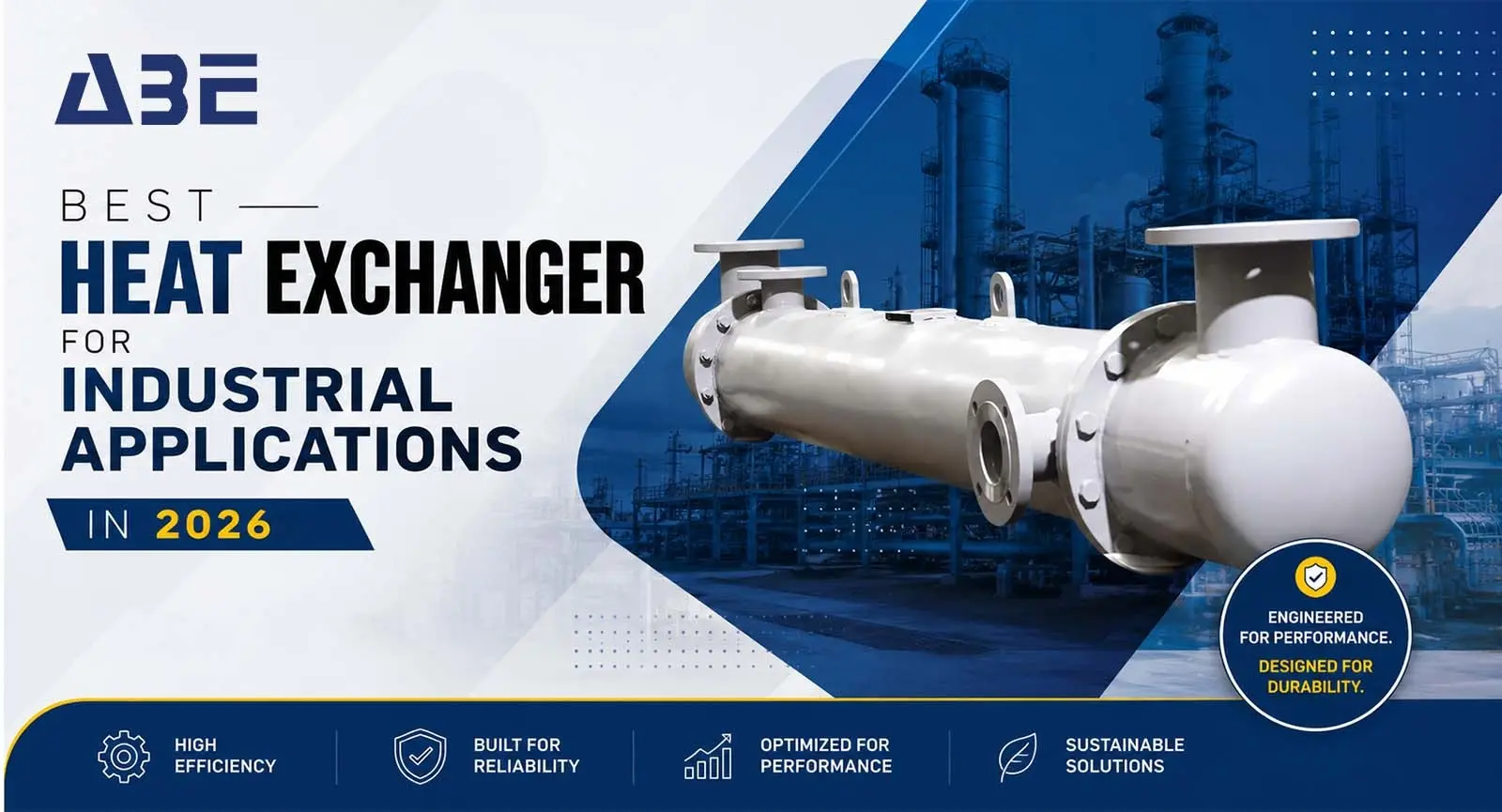
The workhorse of heavy industry. A bundle of tubes inside a cylindrical shell, one fluid through the tubes and the other flowing around them. Heat moves through the tube walls.
Shell and tube units are built for the demanding end of the operating spectrum. High pressures, high temperatures, corrosive fluids, heavy-duty continuous operation. The tube bundle is typically removable, which makes inspection and cleaning manageable without pulling the whole unit offline.
Oil and gas, petrochemical, power generation, and chemical processing. These are the environments shell and tube heat exchangers were built for and where they continue to perform well.
Plate Heat Exchanger
Corrugated metal plates stacked together, fluids running in alternating channels between them. The corrugation creates turbulence that pushes heat transfer efficiency significantly higher than a smooth surface would allow.
Compact is the word that comes up most often with plate heat exchangers. For the same thermal duty, they take up considerably less floor space than a shell and tube unit. Capacity can also be expanded by adding plates rather than replacing the unit entirely.
The trade-off is operating limits.Plate heat exchangers suit moderate temperatures and pressures. Push beyond those limits, and the design starts to struggle. Food processing, dairy, pharmaceutical, and HVAC applications are where they are most commonly found.
Shell and Tube Evaporator
A shell and tube design adapted for processes where one of the fluids changes phase from liquid to vapour. Refrigeration systems, industrial cooling, and certain chemical processes use these where phase change is part of what needs to happen.
Chiller Condenser
Sits on the other side of the refrigeration cycle from the evaporator. Takes refrigerant vapour and condenses it back to liquid by moving the heat out to a cooling medium. Found in industrial chillers, cold storage facilities, and process cooling setups.
Water-Cooled Condenser
Water is the cooling medium here. It condenses refrigerant or process vapour more efficiently than air at higher heat loads. Large-scale industrial cooling and HVAC systems use this type for that reason, provided the water supply is not a limiting factor on site.
Ammonia Condenser
Ammonia works well as a refrigerant but needs condensers designed around its specific properties. Standard materials and construction are not suitable. Cold storage, food processing, and large-scale industrial refrigeration are where ammonia condensers are most commonly found and where the design requirements matter most.
Shell Tube Oil Cooler
A shell and tube unit built for oil cooling. Hydraulic systems, compressors, gearboxes, and industrial machinery. It keeps oil temperature within the operating range, maintains the right viscosity, and stops heat from shortening the life of the equipment on it.
Industries That Rely on Heat Exchangers
Thermal power and power generation. Oil and gas. Chemical and petrochemical processing. Food and beverage production. Cement, mining, textiles, cryogenic applications, and water treatment. The list covers most of the heavy industry because temperature control at scale is a requirement across all of it, not a niche concern.
What changes between sectors are which type of heat exchanger fits, what materials are appropriate, and what the maintenance and cleaning requirements look like in practice.
What Actually Matters When Specifying One
Operating temperature and pressure
These two numbers do a lot of the initial filtering. High pressure and high temperature point toward the shell and tube. More moderate conditions open up options.
Fluid characteristics
Corrosive, viscous, particulate-laden, or phase-changing fluids each affect which design works and which materials hold up. A unit that is right for clean water on both sides is not automatically right for a process fluid with aggressive chemical properties.
Thermal duty and sizing
It is undersized, and the unit cannot meet the process requirement. Oversized and capital are wasted. Getting the sizing right means working through the actual thermal load, the temperature differential between the fluids, and the heat transfer coefficient of the chosen design.
Cleaning and maintenance access
Fouling happens in most industrial processes. How the unit is cleaned, how often, and how much downtime that involves is worth thinking about before the purchase, not after the first fouling event.
Available space
Plate heat exchangers win on footprint. Shell and tube units need more room but handle more demanding conditions. If space is tight and operating conditions are moderate, the plate design makes sense. If conditions are extreme, space has to be found for the shell and tube.
To Wrap Up
There is no single best heat exchanger for every industrial application. The right one depends on what the process demands, what the fluids are, and what the operating conditions look like day to day. Getting that match right from the start is considerably less expensive than correcting it after installation.
ABE & HEX has been manufacturing heat exchangers since 2009, with over 4,700 completed projects across the power, oil and gas, food processing, chemical, and refrigeration industries. If you are specifying equipment for a new installation or replacing an existing unit, reach out to the team and start with the process requirements.
Frequently Asked Questions
How do we know which type of heat exchanger is right for our process?
Start with operating temperature, pressure, and fluid type. Those three narrow the options significantly. From there, thermal duty and available space usually determine the final choice. Sharing the process conditions with a manufacturer who has seen a wide range of applications tends to get to the right answer faster than working through it in isolation.
How often does a heat exchanger need to be cleaned or serviced?
Depends on the process fluid and how much fouling occurs. Some applications run for years between interventions. Others need cleaning every few months. The design choice affects this too. Shell and tube units with removable bundles and gasketed plate units are both relatively accessible. The cleaning frequency should factor into the selection, not just the initial performance specification.
What causes a heat exchanger to underperform over time?
Fouling is the most common cause. Scale, deposits, and biological growth on heat transfer surfaces reduce efficiency over time. Correct sizing, appropriate material selection, and a regular maintenance schedule keep performance from degrading faster than it should.
Can a heat exchanger be customised for a specific application?
Yes. Tube materials, shell dimensions, baffle configuration, number of passes, and connection layout can all be specified for the application. Standard units suit many situations, but custom configurations are often necessary for unusual fluid combinations, extreme operating conditions, or specific space constraints.
What is the typical service life of an industrial heat exchanger?
A well-specified and properly maintained unit can run for many years, sometimes decades. The variables are fluid aggressiveness, operating conditions, maintenance quality, and whether the original specification matched the actual application. Units that are pushed beyond their design parameters or inadequately maintained tend to fail well before their potential service life.